
SunRail Sunshine Corridor: How Rail Expansion Could Shape Orlando’s Next Phase of Growth
Central Florida is growing fast, and transportation is becoming one of the region’s most important conversations. Roads, airports, rail systems, tourism corridors, and commercial districts all have to work together if Orlando is going to keep moving efficiently.
That is why the proposed SunRail Sunshine Corridor matters.
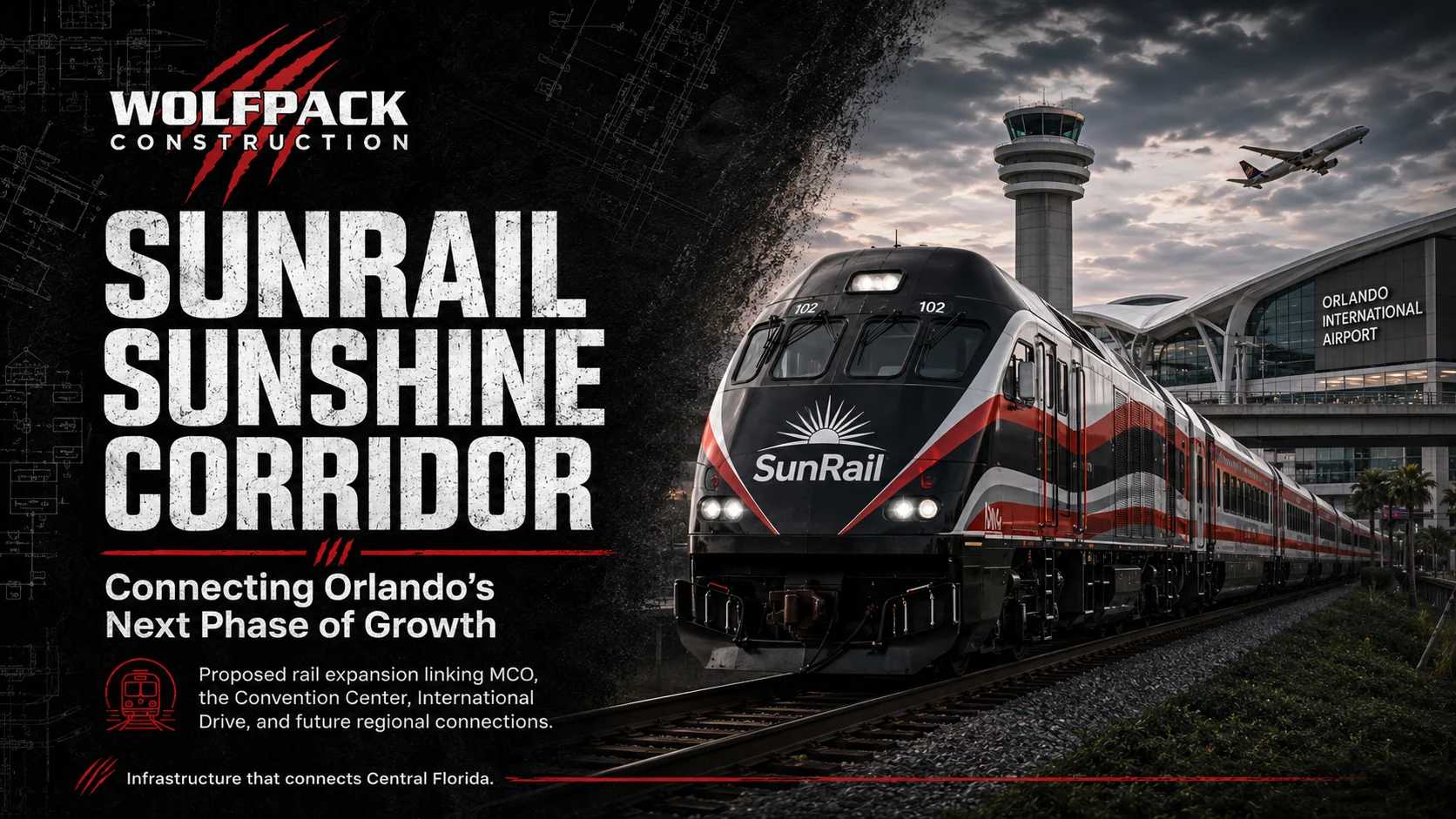
The Sunshine Corridor is a proposed rail expansion that would connect Orlando International Airport, the Orange County Convention Center, South International Drive, and potentially the Disney Springs area. It would also create stronger connections between SunRail commuter service and Brightline’s intercity passenger rail network.
For Orlando, this is more than a transportation project. It is a long-term infrastructure move that could influence tourism, workforce mobility, commercial development, real estate investment, and future construction demand across Central Florida.
What Is the Sunshine Corridor?
The Sunshine Corridor is a proposed east-west rail corridor designed to improve regional mobility through some of Orlando’s most important economic areas. The concept focuses on connecting Orlando International Airport to major destinations such as the Orange County Convention Center, International Drive, South International Drive, and potentially Disney Springs.
The corridor is being evaluated as a way to expand SunRail commuter service while also accommodating future intercity passenger rail connections. That matters because Orlando’s current transportation system is heavily dependent on roadways, rideshare, rental cars, buses, and private vehicles.
A rail connection between the airport, convention district, tourism corridor, and existing SunRail network would give residents, employees, visitors, and business travelers another way to move through the region.
Why This Project Matters for Orlando
Orlando’s economy depends on access. Every day, workers travel to hotels, restaurants, construction sites, offices, theme parks, medical centers, airports, and convention spaces. Visitors move between the airport, attractions, hotels, restaurants, entertainment districts, and business events.
When transportation options are limited, the pressure falls on roads.
The Sunshine Corridor could help reduce some of that pressure by creating a better connection between major activity centers. For workers, it could improve access to employment areas. For visitors, it could create a smoother path between the airport and the tourism corridor. For businesses, it could support stronger customer access and more predictable mobility.
In a region where growth continues to push demand higher, transportation infrastructure becomes a competitive advantage.
Connecting the Airport, Convention Center, and Tourism Corridor
The strongest part of the Sunshine Corridor concept is the destinations it aims to connect.
Orlando International Airport is one of Central Florida’s most important economic engines. The Orange County Convention Center supports major business travel and event activity. International Drive and South International Drive are packed with hotels, restaurants, retail, entertainment, and tourism-related development.
Connecting these areas by rail could create a more complete transportation system for Central Florida.
This is especially important because Orlando’s tourism economy does not operate in one location. It stretches across airport infrastructure, hotel districts, convention spaces, theme parks, restaurants, shopping centers, and transportation corridors. Better rail connectivity could help these areas function more like one integrated economic zone.
The Construction and Development Impact
Major transportation projects create ripple effects.
If the Sunshine Corridor moves forward, the work would likely involve station planning, track infrastructure, bridges, utilities, drainage, road coordination, pedestrian access, parking, signage, lighting, and surrounding site improvements. These are not small efforts. Rail infrastructure requires major coordination between public agencies, private stakeholders, engineers, contractors, property owners, and surrounding communities.
But the construction impact does not stop with the rail line itself.
Transit access can influence nearby development patterns. Properties near stations often become more attractive for hotels, mixed-use projects, restaurants, retail centers, office space, multifamily housing, and service-based businesses. Existing commercial properties may also need renovations, exterior upgrades, parking improvements, tenant buildouts, and accessibility improvements to stay competitive.
Infrastructure creates movement. Movement creates demand. Demand creates construction opportunity.
What It Means for Business Owners and Investors
For business owners and investors, the Sunshine Corridor is worth watching closely because transportation shapes value.
When a corridor improves access to major destinations, the surrounding properties often become more strategic. Businesses near future stations may benefit from higher visibility, better customer access, and stronger connection to tourism and employment centers. Investors may look at surrounding parcels, commercial properties, and redevelopment opportunities differently once rail access becomes part of the long-term plan.
This does not mean every property automatically becomes more valuable. But it does mean that infrastructure planning can shift the conversation.
Smart owners pay attention early. They look at where access is improving, where traffic patterns may change, where new stations could go, and where commercial demand may increase over time.
Why Workforce Mobility Matters
The Sunshine Corridor is not only about tourists. It could also help Central Florida’s workforce.
Thousands of employees travel daily to Orlando’s airport, hotels, convention center, restaurants, attractions, maintenance facilities, construction sites, and service businesses. Many of those jobs are located in areas where commute options can be limited or expensive.
A stronger rail network could help connect workers to major employment centers with less dependence on personal vehicles. That could support employers, reduce transportation barriers, and improve regional mobility.
For a growing metro area, workforce access is not just a social issue. It is an economic issue.
A Long-Term Infrastructure Play
The Sunshine Corridor is still in the planning and study phase. That is important. This is not a completed project, and the final route, cost, timeline, funding structure, and station details still need to be evaluated.
But the fact that the project is moving through study and public review shows how seriously Central Florida leaders are thinking about future transportation needs.
Large infrastructure projects take years to plan, fund, design, permit, and build. The decisions being studied today could shape how Orlando grows for decades.
Final Thoughts
The SunRail Sunshine Corridor could become one of the most important transportation projects in Central Florida’s future. By connecting Orlando International Airport, the Convention Center, International Drive, and major tourism areas, the project has the potential to change how people move through the region.
For Orlando, this is about more than rail. It is about access, growth, construction, real estate, tourism, workforce mobility, and long-term economic planning.
At Wolfpack Construction, we believe growth is built through smart planning and strong execution. As Central Florida continues expanding, infrastructure projects like the Sunshine Corridor remind us that the future is not only about where we build — it is about how we connect.